
Running a Sex Offender Check in Bay County
The Florida Sexual Offender/Predator Registry is the main official channel for a Bay County search. FDLE manages the statewide system, while the Bay County Sheriff's Office completes local registration work and reports updates. A reader may look for one person by name or leave the name blank and use Bay County, a city, or ZIP code to review an area.
Choose the tool that matches the question. The person search is useful when the name is known. County and ZIP searches show a broader area. Neighborhood search begins with an address and radius. Separate university and Internet-identifier searches answer narrower questions. For a cross-state search, the national NSOPW system adds other jurisdictions, but FDLE remains the source for Florida definitions, schedules, and correction contacts.
Search Bay County Without a Name
A location search is often more useful for community awareness than guessing a name. On the detailed FDLE form, leave the first and last name blank, choose Bay from the County list, then narrow by city or ZIP only if needed. At least one name or location field must be supplied. Optional status, offender-type, thumbnail, and alias settings refine the output.
The county list and the neighborhood tool answer different questions. A county search returns records connected with Bay County. Neighborhood search asks for an address, city, ZIP, and radius, then measures from that point. Results can change when a registrant moves or when an agency sends updated information, so save an alert instead of treating one search as permanent.
FDLE also offers a Public Data File for a county or statewide CSV. That channel requires an email address, county selection, CAPTCHA, and download action. It is better suited to broad public-data review than the printable selection tool, which limits a batch to 25 chosen records. Neither option should be confused with a certified criminal-history product.
The official detailed search form shows the full set of filters.
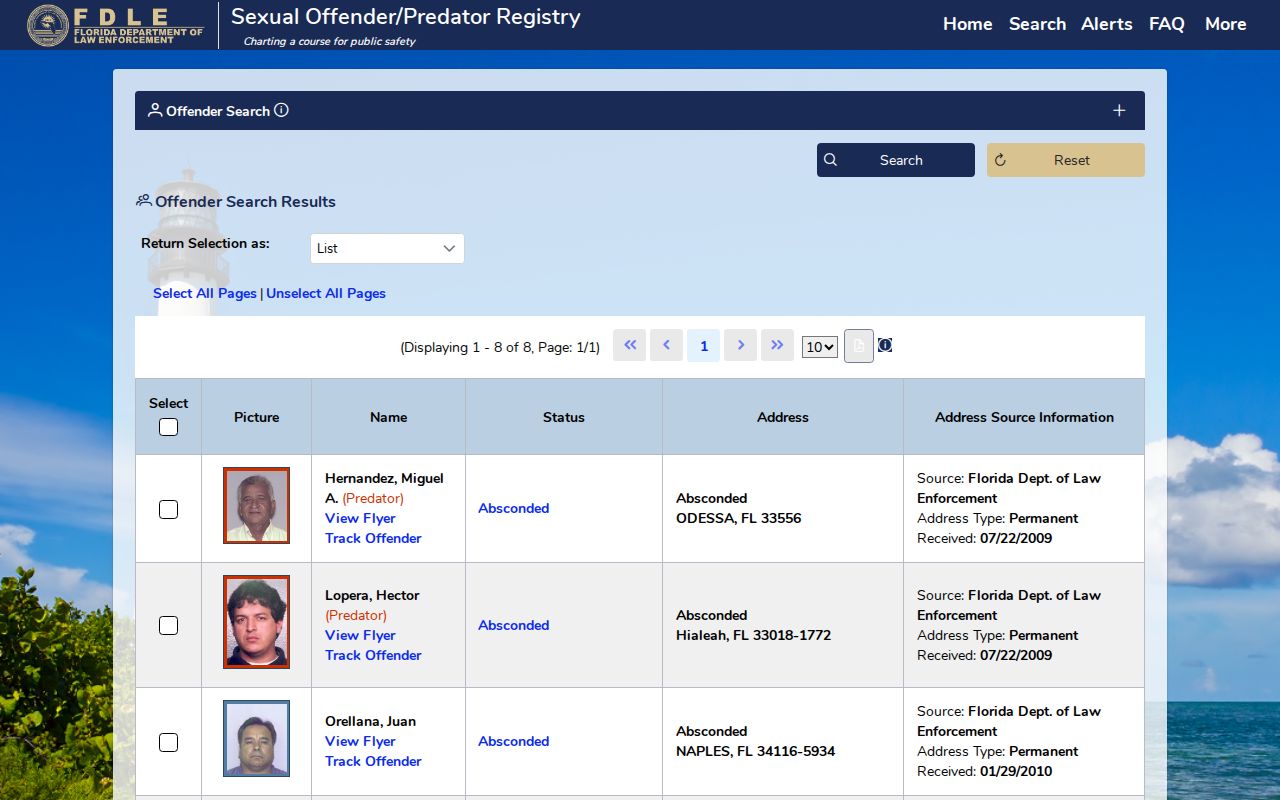
Those controls let a Bay County reader move from a broad location check to a narrower result without relying on an unofficial people-search service.
Searching the Florida Sexual Offender/Predator Registry
Use the official FDLE form and match more than a name before drawing a conclusion. Partial names are accepted, and aliases can be included. A common name may return several records, while a location search may include people with different registration statuses.
- Open FDLE's detailed registry search and choose a person, county, city, ZIP, or other supported search path.
- Enter at least one identifying or location field, then choose optional offender type, status, thumbnails, or aliases.
- Review the result list and compare the photo, aliases, physical description, address, and status.
- Open the official flyer for details, then contact FDLE or local law enforcement if information appears wrong or noncompliance is suspected.
| Search field | How it works | Bay County use |
|---|---|---|
| First and last name | Partial names are accepted | Use when a person is known |
| City, county, or ZIP | Names may remain blank | Select Bay for a county list |
| Offender type | Both or a Florida designation | Avoid treating it as a federal tier |
| Status | Includes released, supervised, confined, absconded, and other choices | Distinguishes current registry circumstances |
| Thumbnails and aliases | Optional checkboxes | Help compare similar names |
Bay County Registry Labels Explained
Florida's public categories are Sexual Offender and Sexual Predator. A sexual predator designation follows Florida law and a court or statutory determination. It is not simply a label for the highest of three federal tiers. The registry also includes qualifying juvenile registrants, and public status choices can indicate confinement, supervision, release subject to registration, deportation, civil commitment, or absconded status.
A listing therefore answers a regulatory question: whether and how a person appears in the Florida registry. It does not show every arrest, every court case, or a complete FDLE criminal history. Readers seeking the broader county records landscape should use the Bay County criminal history overview to identify the separate clerk, sheriff, and FDLE channels.
The status field deserves the same care as the designation. Supervised by FDC, supervised by DJJ, supervised by U.S. Probation, confined, released subject to registration, deceased, deported, civil commitment, and absconded are distinct portal choices. Read the profile's current wording rather than inferring status from the qualifying conviction date.
What a Registry Profile Shows
FDLE calls the public record a flyer. Review it as a group of identifying, registration, and qualifying-offense fields. A photo and similar name are not enough for a positive identification. FDLE says a fingerprint comparison is required to establish identity conclusively.
| Identity | Name, aliases, date of birth, sex, race, photo, and Florida designation |
|---|---|
| Physical description | Height, weight, hair, eyes, scars, tattoos, and marks |
| Registration details | Registered residence or transient status, current status, and public occupation data |
| Associated identifiers | Vehicles and, when public, passport, immigration, license, and Internet identifiers |
| Qualifying record | Crime, statute, county, date, conviction information, and supervision or confinement |
| Not disclosed | Victim identity and information protected by law |
The FDLE registry guidance explains what appears on a public flyer.
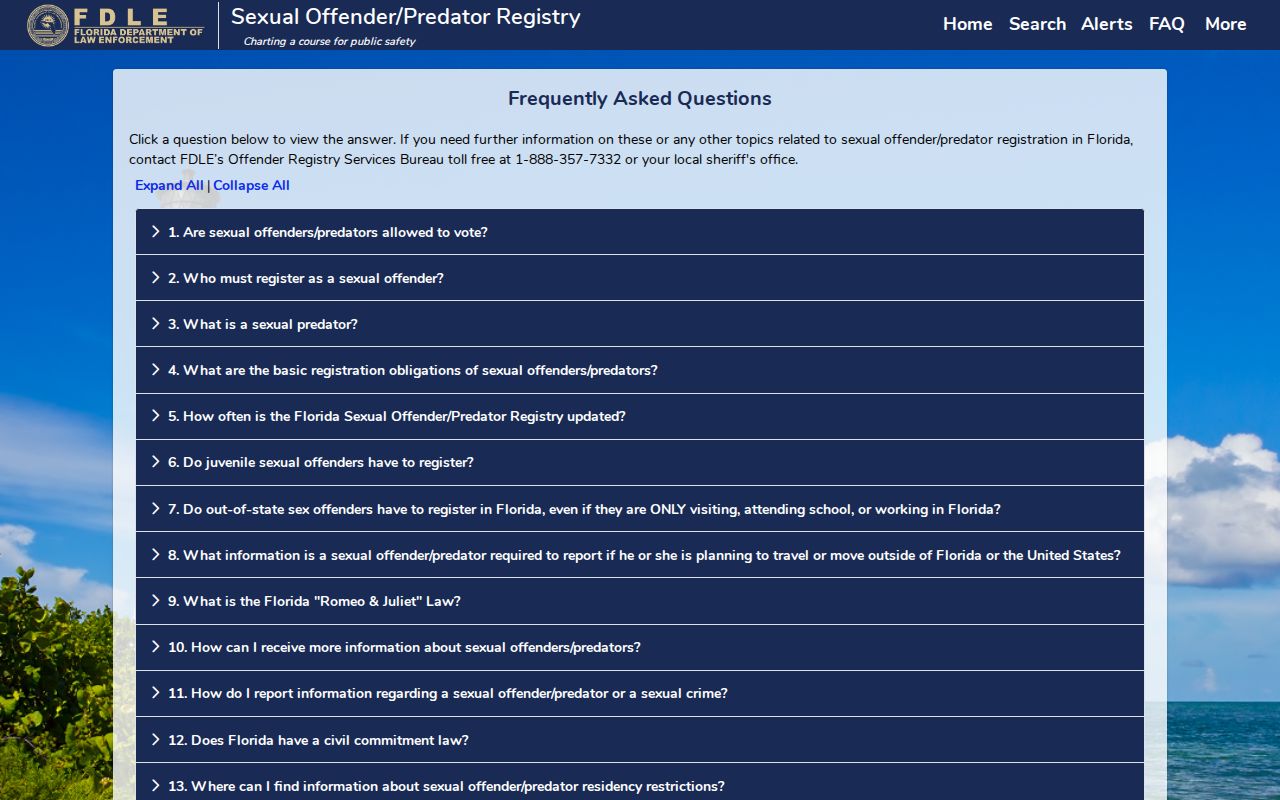
The official field guidance is also the right reference when a profile label is unclear or seems different from a court record.
Bay County Registration at Star Lane
Bay County's official registration location is the Bay County Sheriff's Office at the jail complex, 5700 Star Lane, Panama City. The published hours are Monday through Friday, 8:30 a.m. to noon and 1:00 to 3:30 p.m. The Sheriff's main number is (850) 747-4700. The official location list states neither a fee nor an appointment requirement, so a registrant with a time-sensitive duty should call rather than assume either point.
This counter is not a substitute for the public website. It serves the local registration process, while FDLE publishes the statewide search. Suspected failure to register or inaccurate address information should go to local law enforcement. Questions about correcting the FDLE data can go to 1-888-357-7332 or sexpred@fdle.state.fl.us.
Bay County Registration
5700 Star Lane
Panama City, FL 32404
(850) 747-4700
Weekdays, 8:30 a.m.-noon and 1:00-3:30 p.m.
Registration Requirements and Levels in Florida
Florida generally requires registration for life, subject to narrow statutory relief. Reporting frequency depends on Florida designation, age category, and qualifying offense. The schedule is not a public risk score, and it should not be translated into Tier I, II, or III. Transient registrants also face added prompt reporting and a recurring 30-day cycle.
| Florida category | General duration | Re-registration pattern |
|---|---|---|
| Sexual predator | Generally lifetime, with narrow relief | Quarterly |
| Juvenile registrant and specified adult offenses | Generally lifetime, with narrow relief | Generally quarterly |
| Other adult sexual offenders | Generally lifetime, with narrow relief | Generally semiannual |
| Transient registrant | Underlying Florida requirement applies | Added prompt duties and 30-day reporting |
Birth-month cycles help determine when quarterly and semiannual reporting occurs. A public user should read the current profile status and Florida law instead of estimating compliance from the date of a prior search.
Registration frequency also does not tell a reader how often the public flyer itself will visibly change. Local agencies and other state sources supply updates as events occur. The safest approach is to check the current FDLE entry and use an alert when later movement matters.
Registry Alerts Around a Bay Address
Florida Offender Alert changes a one-time Bay County search into ongoing notice. A subscriber can request email when a registrant moves within a selected distance of a specified location. A second option follows a particular registrant and sends notice if that person moves anywhere in Florida.
That distinction matters. The address alert supports awareness around a home, school, care location, or other place. The person alert follows one official record statewide. Community notification for predators also includes schools and childcare facilities within one mile. Alerts report registry changes; they do not predict conduct or replace ordinary emergency and safety channels.
The registry home and alert options provide the official signup point.
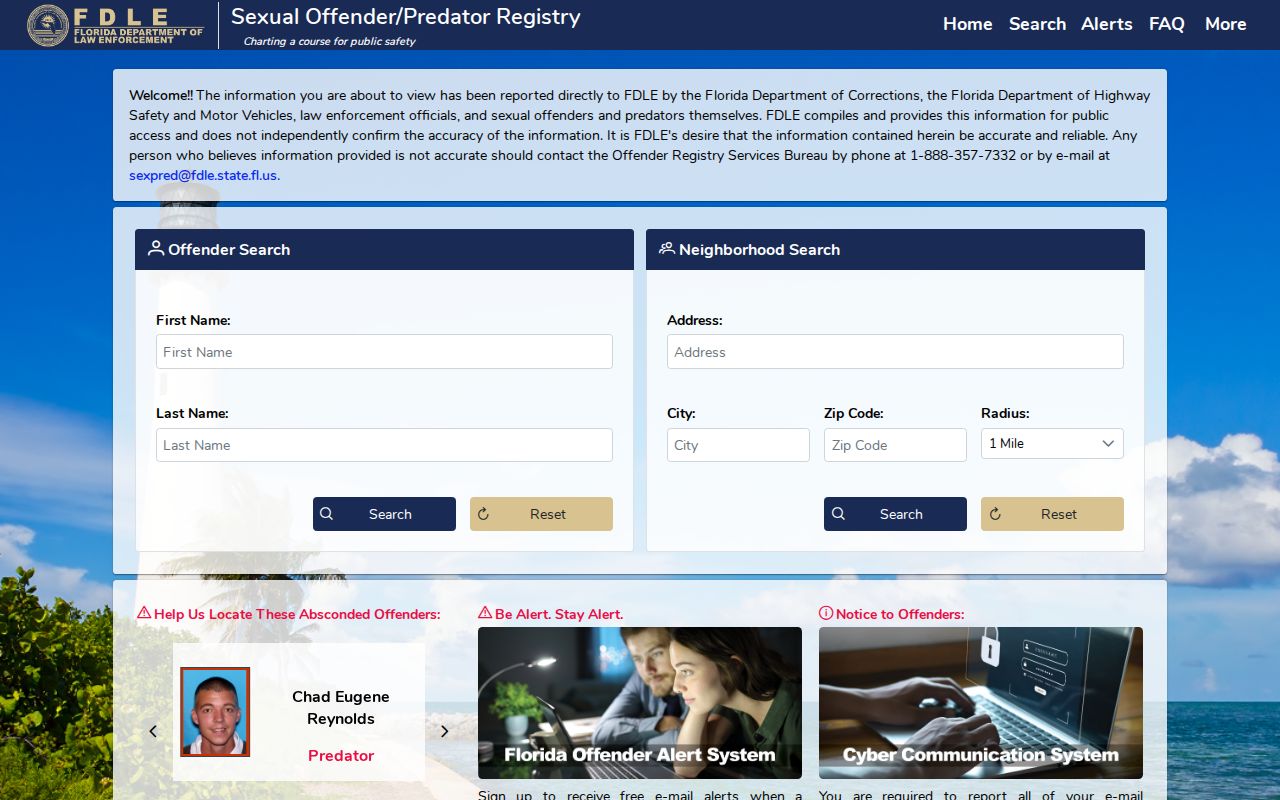
Using the alert tool avoids repeatedly rebuilding the same location search and makes later address changes easier to notice.
Why Bay County Registry Data Changes
FDLE receives information from registrants, law enforcement, the Florida Department of Corrections, and the Department of Highway Safety and Motor Vehicles. Addresses, supervision, confinement, vehicles, and other details can change quickly. FDLE does not independently verify every submitted item before a user sees it.
When a profile appears inconsistent, compare the person and qualifying-offense fields, note the page's update information, and use the correction channel. Do not copy the entry into a new public list or alter it to imply a different official status. For a question that crosses state lines, NSOPW is helpful, but return to FDLE for the controlling Florida record.
Lawful Use and Community Notification
The registry supports public awareness and personal or family safety planning. It does not authorize threats, payment demands, false publication, or alteration of official information. If a Bay County reader suspects a registration failure, the proper response is a report to local law enforcement, not personal confrontation.
Florida misuse warning: Under Florida Statute §775.21, using registry data to secure payment, knowingly presenting false material as public registry information, or materially altering it to misrepresent the record is a first-degree misdemeanor.
Keep the statutory language precise. The cited subsection addresses those specific acts. Other harmful conduct may be governed by other laws, but it should not be attributed to this registry provision without checking the applicable authority.